
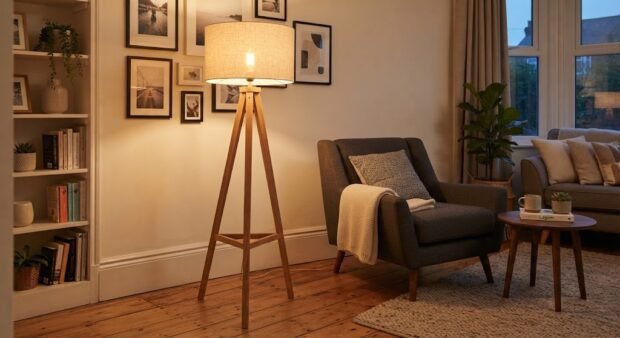

So here’s my problem with most wood floor lamps guides, twelve nice photos, zero actual info. Nobody tells you if a walnut pedestal is going to look off next to your oak dining table. Nobody tells you if a plug-in lamp survives a dog running past it at full speed. That’s basically why I wrote this guide to the best wood floor lamps.
I get asked the same handful of questions constantly. What wood tone actually goes with darker furniture. Whether plug-in lamps are sturdy or you need to call an electrician. How tall a lamp needs to be next to a sectional so it doesn’t look silly. So I went through seven wood floor lamps styles that are everywhere right now, oak, walnut, rattan mixes, the weird sculptural art ones, pulled real specs, and just laid it out plainly.
Why Choose Wood Floor Lamps Over Metal or Plastic
I’ll be honest, durability’s the main reason wood floor lamps win out here. Oak and walnut hold up to daily life way better than painted steel or acrylic, they don’t chip, they don’t fade weird, and honestly a bit of wear just makes them look lived-in instead of trashed. There’s also just, warmth? If your room already feels a little sterile, wood fixes that without you needing to add ten more things to the space.
People forget about resale too. You can sand a wood lamp down and refinish it in five years and it’ll look brand new. A cracked plastic base just goes in a bin somewhere.
And it fits basically anywhere. Same tripod lamp works in a mid-century apartment or a totally modern one. Same oak pedestal fits a farmhouse kitchen or a stiff traditional den. Metal arc lamps look trendy now but who knows how they’ll look in three years, wood doesn’t really have that problem.
The 7 Best Wood Floor Lamps Styles, and What They Cost

Before pulling out a tape measure or comparing paint chips, here’s the lay of the land for these seven wood floor lamps.
Solid oak tripods. Three legs, natural or stained, usually sitting around 58 to 65 inches. Price tends to land between $150 and $350. Scandinavian rooms, mid-century rooms, this is their bread and butter.
Walnut pedestals come next. One solid column, wider shade on top, taller too, 60 to 72 inches, and you’re paying more, $200 to $500. These suit a traditional living room that needs a bit more visual weight in the corner.
Rattan-wood combo lamps. Woven shade, wood base, 54 to 62 inches, $170 to $320. If your place has any coastal or boho leanings, this is probably your lamp.
Sculptural wood floor lamps are their own category honestly, more art than lamp sometimes. Carved, asymmetric, 48 to 70 inches, $300 up to $600. Worth considering if your room’s missing a focal point.
Arch lamps. Wood post holding up a metal arc with a rotating head, 65 to 80 inches, $250 to $550. Built for reading, basically nothing else.
Tree lamps branch out into multiple bulbs, 60 to 68 inches, $280 to $520, and they’re good at filling big open rooms that one regular lamp just can’t handle.
Vintage Edison style. Exposed bulbs, dark stain, brass trim, 55 to 64 inches, $180 to $400. If you’ve got an industrial loft or something close to it, this is the one.
One more thing on build quality, oak and walnut pieces usually come from a single solid board. The more handmade-feeling wood floor lamps often use hand-turned joinery, which just tends to last longer under normal use. If you’re curious how oak and walnut compare more broadly for furniture beyond lighting, our types of wood for home decor guide breaks that down further.
Comparison Table for the Best Wood Floor Lamps
| Material | Durability (1–10) | Best Room Size | Height Range | Price Range | Style Fit |
|---|---|---|---|---|---|
| Solid Oak | 9 | 100–400 sq ft | 58–65 in | $150–$350 | Scandinavian, mid-century, minimalist |
| Walnut Pedestal | 9 | 150–500 sq ft | 60–72 in | $200–$500 | Traditional, transitional, rustic |
| Rattan-Wood Blend | 7 | 80–300 sq ft | 54–62 in | $170–$320 | Coastal, bohemian, tropical |
| Sculptural Wood | 8 | 180–450 sq ft | 48–70 in | $300–$600 | Eclectic, gallery, contemporary |
Rattan’s durability score is lower mainly because the weave frays eventually. Doesn’t mean it’s bad, a decent one still lasts 8 to 10 years. Just don’t expect it to outlive your oak lamp.
Getting the Size and Tone Right for Wood Floor Lamps
This trips people up more than it should, but really it’s just three things going on, height, footprint, and how the wood color plays with what’s already in the room.
Small room, under 150 square feet? Stay under 60 inches, base under 12 inches wide. A tripod won’t get in your way when you’re walking through.
Normal living room, 150 to 300 square feet roughly, you can go 60 to 68 inches without it looking out of place. Pedestal and arch lamps do great here, especially next to a reading chair. Bigger room than that? You can actually go big, 72 inches even, or grab a multi-arm tree lamp so the space doesn’t feel empty.
For wood tone, keep it within two shades of what you’ve already got. Light oak near pine or maple. Walnut and espresso tones near mahogany or cherry. If your furniture’s upholstered instead of wood, just match the undertone, warm woods like oak or teak near beige and cream, cooler tones like whitewashed ash near grays and blues.
Don’t stress too hard about mixing finishes by the way. Brass or black iron hardware bridges the gap fine. A walnut lamp with brass legs sits perfectly well next to oak furniture that has brass handles on it.
Plug-In or Hardwired
Just get plug-in. Ninety-something percent of people should, honestly. No electrician, no wiring changes, and if you move apartments next year the lamp comes with you. Cord should be at least 8 feet, ideally with a foot switch, and a built-in dimmer saves you from buying smart bulbs separately.
Hardwired only really makes sense for permanent built-ins or lamps taller than 72 inches that genuinely need the extra support. That means hiring an electrician and putting in a junction box, a real hassle if you’re renting, so just don’t bother. If you do go the hardwired route, the Electrical Safety Foundation International publishes solid guidance on safe home lighting installation worth a read first.
On the tipping-over worry, people overthink this. Base weighing 8 to 10 pounds, footprint at least 12 inches wide, and you’re basically fine. Tripods are more stable anyway since the weight spreads across three legs instead of one center point. Got small kids or a big dog? Grab one with a metal-wood hybrid base, just for peace of mind.
Where Wood Floor Lamps Actually Go in Your House
Living room first. Put a 60 to 65 inch lamp behind your sofa or armchair and suddenly that corner’s a reading spot. Arch lamps work especially well since the head angles light over your shoulder instead of straight at your face. Throw in a side table and a blanket and honestly that becomes the best seat in the house.
Bedroom, put it beside the bed instead of on the nightstand, frees up space for your phone charger and water glass and whatever else lives there. Fabric or paper shade softens the light more than a bare bulb would. If you can find one with a dimmer, get it, the difference between reading light and falling-asleep light matters more than people think. Keep it close enough that you’re not stretching across the bed to shut it off.
Home office, beside the desk or behind the monitor, angled so light hits from the side, not straight overhead. Overhead just throws weird shadows across whatever you’re working on. An adjustable arm lets you redirect it whenever you need to, which helps with screen glare more than most people expect.
If you want the room to feel finished, put the lamp near other natural stuff, a jute rug, linen curtains, maybe a plant in a ceramic pot. Don’t cram everything into one corner though. Balance the tall lamp with something lower nearby so the room can still breathe a bit. If your existing wood furniture needs a refresh before adding a new lamp into the mix, our wood care products guide covers what’s actually worth buying.
Where to Actually Buy Wood Floor Lamps
Stick to places that show real measurements, actual photos of the product (not just renders), and a return policy that doesn’t read like a legal trap. We try to do exactly that on our end when recommending wood floor lamps, full specs, honest breakdowns of materials, and someone around if you have questions about bulbs or assembly.
Couple worth mentioning: the Svelte Floor Lamp at $315, slim column, adjustable fabric shade, works in tighter spaces. The Dodie at $550, sculptural walnut base with a linen drum shade, better for a bigger living room. If money’s tight, the Calla Flowers Floor Lamp at $177 gets you a natural wood tripod without draining your wallet.
So, Bottom Line
Really just three things decide this for the best wood floor lamps, room size, furniture color, what you actually need the light for. Small place, lighter furniture, go slim, oak or rattan tripod under 60 inches. Bigger room, darker furniture, walnut pedestal or a sculptural piece somewhere around 60 to 70 inches. Need it for reading or actual work, get an adjustable arm and don’t skimp on the bulb, at least 60W equivalent.
Before you buy anything, grab a tape measure. Check the corner, note how far the nearest outlet is, make sure nothing’s blocking where the lamp would sit. Then filter by height and budget, pick something within two shades of what you already own. Once it’s home, E26 or E27 LED bulbs, dimmable if the lamp supports it, and that’s it, you’re set for years. And if you’re building out the rest of the room around it, our wooden furniture buying guide covers what to check before buying anything else solid wood.
Frequently Asked Questions
What wood actually survives 10+ years of daily use? Oak or walnut, no real competition there. Oak resists dents better day to day. Walnut just looks richer the older it gets. Stay away from veneer if you want wood floor lamps that last, and if there’s kids or pets around, a reinforced base is worth the extra cost.
Will a wood floor lamp even work in a small apartment? It’ll work fine if you size it right, and this holds true across pretty much all wood floor lamps styles. Stay under 60 inches for anything under 150 square feet, and skip wide bases or multi-arm designs, they just eat floor space you don’t have. Plug-in makes the most sense if you’re renting anyway.
How do I actually match a lamp to furniture I already own? Two shades, that’s the rule. Light oak near pine or maple, walnut near mahogany or espresso. If it’s upholstered, go by undertone instead, warm wood for beige rooms, cooler wood for gray or blue ones. Brass or iron hardware fixes most mismatches if you’re stuck.
Should I worry about plug-in lamps tipping over? Not really, as long as the base is 8 to 10 pounds and at least 12 inches wide. Hardwired is only worth the hassle for permanent setups or anything taller than 72 inches.
Can old-school Edison lamps take modern LED bulbs? Yeah, most use a standard E26 or E27 base, common across most wood floor lamps regardless of style. Grab LED filament bulbs specifically for the exposed-bulb look, same warm glow, way less heat. Just check the wattage rating first, usually somewhere around 60 to 100W equivalent.