Few tools add as much capability to a woodworking shop as a router. With the right bits, it can round over edges, cut decorative profiles, plow dadoes and grooves, trim edge banding flush, cut joinery, and duplicate shapes from templates. But “router” covers a range of tools, from small trim routers you hold in one hand to large plunge routers that live in a router table. This guide explains the types, the features that matter, and how to match a router to the work you actually do.
If you are just getting started, have a look at our Start Here page for an overview of building a beginner tool kit. Our methodology for guides like this is explained on How We Review.
Key takeaways
- There are three main router types: compact (trim), fixed-base and plunge. Combo kits include both fixed and plunge bases.
- A combo kit with a mid-size motor is the most versatile first router for most hobbyists.
- Collet size matters: 1/2-inch shank bits are stiffer and safer for larger profiles; 1/4-inch fits compact routers.
- Variable speed is essential for running larger bits safely.
- Good dust collection, smooth depth adjustment and comfortable handles affect daily use more than headline power.
What a router does
A router is a motor that spins a cutting bit at very high speed. You either move the router over the workpiece (handheld routing) or mount it upside down in a router table and move the workpiece past the bit. The bit determines the cut: roundover, chamfer, straight, rabbeting, flush-trim, cove, ogee, dovetail and many more. That flexibility is why a router is often called the most versatile power tool in the shop.
Types of routers
Compact (trim) routers
Compact routers are small, one-hand tools originally designed for trimming laminate. Today they are popular for edge work: roundovers, small chamfers, flush-trimming, hinge mortises and light grooves. They usually accept 1/4-inch shank bits only. Many are available in cordless versions.
- Light and easy to control with one hand
- Great for edge profiles and small details
- Affordable and beginner-friendly
- Limited power for large bits
- Usually 1/4-inch collet only
- Not ideal for router-table use
Fixed-base routers
On a fixed-base router, you set the bit depth before switching on, and it stays put during the cut. Fixed bases are simple, accurate and excellent for edge profiles and for mounting in a router table.
- Precise, repeatable depth settings
- Well suited to router tables
- Simple and durable design
- Cannot plunge into the middle of a board safely
- Less versatile for stopped grooves and mortises
Plunge routers
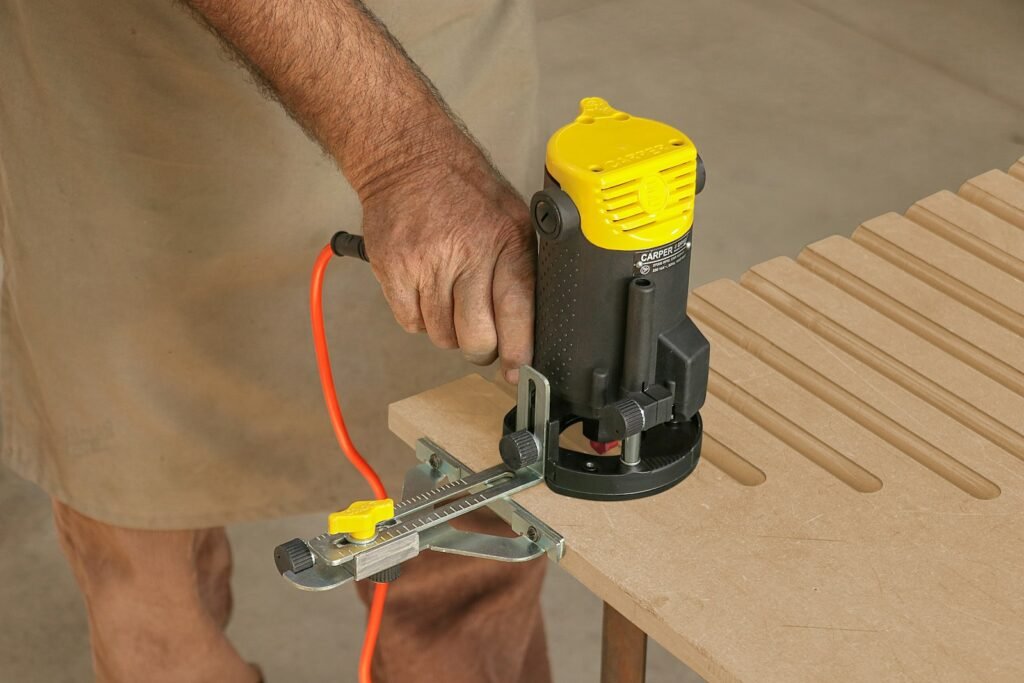
A plunge router’s motor rides on spring-loaded posts so you can lower the spinning bit into the workpiece and raise it again. That makes stopped dadoes, mortises, inlay work and template routing much easier. Depth stops (often a turret) let you take multiple passes to a final depth.
- Starts and stops cuts in the middle of a board
- Multi-step depth turret for progressive passes
- Ideal for mortises, inlays and template work
- Slightly more complex to set up
- Heavier and taller, which can feel less stable on edges
Combo kits
A combo kit pairs one motor with both a fixed base and a plunge base. You swap the motor between bases in seconds. For many hobbyists, this is the best value because it covers almost every routing task.
Comparison table
| Router type | Typical collet | Best uses | Router table? |
|---|---|---|---|
| Compact / trim | 1/4 inch | Edge profiles, flush trimming, small details | Rarely |
| Fixed-base (mid-size) | 1/4 and 1/2 inch | Edge profiles, joinery, table work | Yes |
| Plunge (mid-size) | 1/4 and 1/2 inch | Stopped cuts, mortises, templates | Possible |
| Combo kit | 1/4 and 1/2 inch | All-around use | Yes (fixed base) |
| Large plunge / fixed | 1/2 inch | Big profiles, raised panels, heavy table use | Yes |
Features to look for
Motor power
Routers are often grouped by size: compact, mid-size and full-size. Mid-size routers handle the vast majority of hobby tasks, including most router table work. Large-diameter bits such as panel raisers call for a full-size router, ideally mounted in a table. Manufacturers rate power differently, so compare within categories rather than chasing the biggest number.
Collet size
The collet holds the bit. Bits with 1/2-inch shanks are stiffer, vibrate less and are safer for larger profiles. A router that accepts both 1/4-inch and 1/2-inch collets gives you access to the widest range of bits. Always insert the shank fully, then back it out slightly, before tightening.
Variable speed
Small bits cut best at high speed; large-diameter bits must run slower to stay safe. Variable speed control is a must if you will ever use bits larger than simple roundovers. Check the bit manufacturer’s recommended speed range for big bits.
Soft start and electronic feedback
Soft start reduces the jolt when the motor spins up, which makes handheld routing more controllable. Electronic feedback (sometimes called constant-speed control) helps the motor maintain speed under load for cleaner cuts.
Depth adjustment
Look for a smooth, precise depth adjustment with a fine-adjust knob. If you plan to use a router table, above-the-table height adjustment is a big convenience.
Ergonomics and visibility
Handles should feel secure and the switch should be easy to reach without letting go. A clear sub-base and built-in light help you see the bit and the line you are following.
Dust collection
Routers throw chips everywhere. A dust port or shroud you can connect to a shop vacuum makes a huge difference, especially with plunge cuts and grooving.
Corded vs cordless
Cordless compact routers are excellent for edge work and are free of cord snags. Larger routing tasks and table use still tend to favor corded models because of continuous runtime and power.
Choosing bits wisely
Start with a small set of quality bits rather than a giant bargain kit. A good beginner selection includes a straight bit, a roundover bit, a chamfer bit, a flush-trim bit and a rabbeting bit with interchangeable bearings. Carbide-tipped bits stay sharp much longer than high-speed steel. Keep bits clean of pitch for cooler, smoother cuts.
Router table or handheld?
Handheld routing is best for large or awkward workpieces and edge work on assembled projects. A router table is safer and more accurate for small parts, narrow stock, repeat cuts and large-diameter bits. Many woodworkers start handheld and add a simple table later. A fixed base from a combo kit is often the easiest motor to mount in a table.
Safety note
Router bits spin extremely fast and can grab the workpiece if fed incorrectly. Always feed against the rotation of the bit (for handheld edge routing, that typically means moving left to right along an edge as you face it, with the router on top). Take multiple shallow passes instead of one deep one, clamp workpieces securely, unplug before changing bits, and wear eye and hearing protection. Fine dust from routing is a respiratory hazard, so consider a dust mask or respirator. Our safety gear section covers the basics.
Recommended path for beginners
- Start with a mid-size combo kit if your budget allows; it covers both fixed and plunge work.
- Add a compact router later for quick edge profiles and flush trimming.
- Build or buy a simple router table once you need to rout small parts safely.
- Practice on scrap before working on finished pieces.
For more foundational skills, browse our beginner guides and other power tools articles.
Frequently asked questions
Is a trim router enough for a beginner?
For edge profiles and light work, yes. If you want to cut dadoes, use a router table or run larger bits, a mid-size router will serve you better.
Should my first router be plunge or fixed-base?
A combo kit with both bases is the most flexible choice. If you must choose one, a plunge router handles a wider range of handheld tasks, while a fixed base is better for table use.
What does variable speed do?
It lets you slow the bit for large-diameter cutters, which reduces burning, vibration and risk. It is strongly recommended for any router you plan to use with bigger bits.
Why are 1/2-inch shank bits preferred?
The thicker shank is stiffer, so it vibrates less and is less likely to deflect or break under load, giving cleaner and safer cuts.