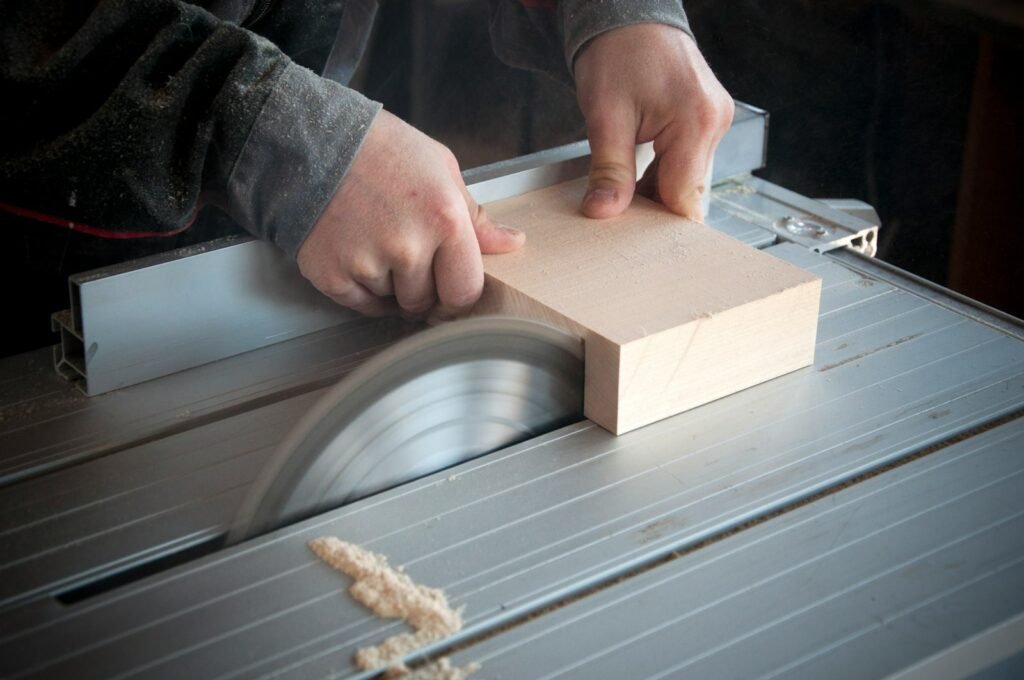
A table saw is often called the heart of a woodworking shop, and for good reason. It rips boards to width, crosscuts panels, cuts dadoes and rabbets, and makes repeatable, square cuts that are hard to match with handheld tools. It is also one of the most expensive and potentially dangerous tools you will buy, so it pays to understand what actually matters before you spend money. This guide walks through the main types of table saws, the features worth paying attention to, and the questions to ask yourself before you choose.
If you are brand new to the hobby, you may want to read our Start Here page first. And if you are curious about how we put guides like this together, see How We Review. We research specifications, manufacturer documentation and established woodworking practice; we do not claim hands-on testing we have not done.
Key takeaways
- Decide on the saw type (jobsite, contractor, hybrid or cabinet) based on your space, power supply and the kind of projects you build.
- Fence quality matters more than almost any other feature for accurate, safe cuts.
- Look for solid safety equipment: a riving knife, blade guard and anti-kickback pawls at minimum.
- Rip capacity determines how wide a sheet good you can cut; match it to the projects you plan.
- Dust collection, table flatness and ease of blade adjustment make a big difference in daily use.
- Budget for a good blade, push sticks and personal protective equipment, not just the saw itself.
The four main types of table saws
Jobsite (portable) table saws
Jobsite saws are compact, lightweight saws designed to be carried to a work location. Many come with a folding wheeled stand. They run on standard household current and typically use a universal (brushed or brushless) motor that is loud but powerful for its size. Their tables are small, and fences vary widely in quality, but they are an excellent starting point for hobbyists with limited space, such as a garage that also needs to hold a car.
- Portable and easy to store
- Runs on standard household outlets
- Usually the most affordable entry point
- Smaller table and rip capacity
- Louder motors and more vibration
- Fences can be less precise than larger saws
Contractor table saws
Traditional contractor saws are heavier, with an open stand and an induction motor that often hangs off the back. They were once the standard step-up saw for home shops. Today many buyers skip directly to hybrid models, but used contractor saws can still be a good value if they are in sound condition.
Hybrid table saws
Hybrid saws blend features of contractor and cabinet saws: an enclosed base, trunnions often mounted to the cabinet or table, and induction motors that usually run on standard household current. They are quieter and smoother than jobsite saws and offer larger cast-iron tables, but they are heavy and are meant to stay put (or move on a mobile base).
- Smoother and quieter induction motors
- Larger cast-iron tables and better fences
- Enclosed base helps dust collection
- Heavy and not truly portable
- Higher cost than jobsite saws
- Needs dedicated shop space
Cabinet table saws
Cabinet saws are the heavy-duty option: massive cast-iron tops, robust trunnions, powerful induction motors and excellent dust control. Many require a 240-volt circuit, which may mean hiring an electrician. They are built to last decades but are overkill for many hobbyists.
- Maximum power, mass and stability
- Very smooth cuts with little vibration
- Built for long-term heavy use
- Most expensive category
- Often requires 240-volt wiring
- Very heavy and space-hungry
Quick comparison table
| Type | Portability | Typical power supply | Best for |
|---|---|---|---|
| Jobsite | High | Standard household outlet | Small shops, beginners, on-site work |
| Contractor | Low to moderate | Usually household outlet | Budget home shops, used-market buyers |
| Hybrid | Low (mobile base helps) | Usually household outlet | Serious hobbyists |
| Cabinet | Very low | Often 240-volt | Dedicated shops, heavy daily use |
Features that matter most
The rip fence
If you remember only one thing from this guide, make it this: the fence is the most important part of a table saw. A good fence locks parallel to the blade every time, slides smoothly, and does not deflect when you push a board against it. Check whether the fence locks at both the front and back or only at the front, whether its face is flat, and whether the scale is easy to read and adjust. A fence that drifts out of parallel is not just annoying; it can pinch the workpiece against the blade and cause kickback.
Rip capacity
Rip capacity is the maximum distance between the blade and the fence. If you want to cut plywood and other sheet goods, look at how far the fence extends to the right of the blade. Smaller jobsite saws usually cannot rip down the middle of a full sheet, which is fine if you break sheets down with a circular saw first (see our tool comparisons for more on that).
Motor and power
Universal motors (common on jobsite saws) are compact and powerful but loud. Induction motors (common on hybrid and cabinet saws) are quieter, longer-lived and smoother under load. Instead of focusing only on horsepower numbers, which manufacturers measure in different ways, think about the material you plan to cut. Ripping thick hardwood demands more power than cutting plywood or softwood.
Blade size and arbor
The most common blade diameter for home shop saws is 10 inches, which gives a good balance between cut depth and blade availability. Also check whether the arbor is long enough for a dado stack if you plan to cut dadoes and grooves, and confirm the saw supports a dado stack at all, since some models do not.
Table size and flatness
A larger, flat table supports workpieces better and makes cuts safer. Cast iron is heavy and dampens vibration; aluminum is lighter and common on portable saws. Look at the miter slots too: standard-size T-slots make it easier to use aftermarket sleds and jigs.
Blade height and bevel adjustment
You will adjust blade height and tilt constantly, so the handwheels and locks should be smooth and precise. Check which direction the blade tilts (most modern saws tilt left) and whether there are positive stops at 90 and 45 degrees.
Dust collection
Table saws throw a lot of fine dust. Look at the dust port size and whether the blade is shrouded. Enclosed cabinets usually capture dust better than open stands. Connecting a shop vacuum or dust collector protects your lungs and keeps the shop cleaner.
Safety features: non-negotiable
Every table saw you consider should include, at minimum, a riving knife (a curved metal piece behind the blade that rises and falls with it and helps prevent kickback), a blade guard, and anti-kickback pawls. Some saws also include flesh-sensing technology that stops the blade on contact with skin, which adds cost but is worth considering, especially in shops with multiple users.
Safety note: Table saws demand respect. Always use push sticks or push blocks for narrow rips, never reach over a spinning blade, stand slightly to the side of the blade line, and never freehand a cut without the fence or miter gauge. Wear eye and hearing protection every time. Browse our safety gear section for help choosing protective equipment, and read the owner’s manual before your first cut.
How to choose: questions to ask yourself
- How much space do I have? A shared garage points toward a jobsite saw or a hybrid on a mobile base.
- What power is available? If you do not have a 240-volt circuit, focus on saws designed for standard household current.
- What will I build? Cabinets and furniture from sheet goods need more rip capacity than small boxes and cutting boards.
- Will I move it? If yes, portability outweighs table mass.
- What is my total budget? Remember to set aside money for a quality blade, a crosscut sled or miter gauge upgrade, push sticks and PPE.
Accessories worth budgeting for
- A quality general-purpose or combination blade (the stock blade is often basic).
- Push sticks and push blocks.
- A zero-clearance throat plate for cleaner cuts and better support of small offcuts.
- A crosscut sled, which you can build yourself as a great early project.
- Featherboards to hold work against the fence.
- Outfeed support, such as a roller stand or outfeed table.
Common beginner mistakes
Many new owners buy the saw and skip the setup. Before the first cut, check that the blade is parallel to the miter slot and that the fence is parallel to the blade. Make sure the 90-degree stop is truly square. Another common mistake is removing the riving knife because it seems inconvenient. Keep it on for nearly all through-cuts. Our beginner guides cover basic setup and squaring techniques in more detail.
Table Saws Worth Considering
Popular, well-reviewed options in different sizes. Check the specifications against the features above before you buy.
| Best for | Model | |
|---|---|---|
| Portable, multi-material cutting | Evolution R255TBL+ Table Saw (Next Gen Rage 5-S) | Check price on Amazon |
| Compact jobsite saw with a sliding table | Bosch Professional GTS 10 J (254mm) | Check price on Amazon |
| Accurate rip fence in a small footprint | DEWALT DWE7485 Compact Table Saw 250mm (240V) | Check price on Amazon |
| Keeping hands away from the blade | POWERTEC Safety Push Block and Stick Set (5 pack) | Check price on Amazon |
As an Amazon Associate we earn from qualifying purchases. This does not change the price you pay.
Frequently asked questions
What size table saw do I need for a home shop?
A 10-inch saw is the most common choice for hobbyists. It cuts through typical lumber thicknesses and uses widely available blades.
Is a jobsite saw good enough for furniture?
Yes, many people build fine furniture with jobsite saws, especially if they upgrade the blade, tune the fence carefully and use good outfeed support. The main limitations are table size and rip capacity.
Do I need a 240-volt circuit?
Only for many cabinet saws and some larger motors. Most jobsite and hybrid saws run on a standard household outlet, but check the manufacturer’s electrical requirements.
Can I use a dado stack on any table saw?
No. Some saws, particularly certain compact models, do not accept dado stacks. Confirm arbor length and manufacturer guidance before buying if dadoes are important to you.